Saturday, November 17, 2012

Mississippi River Trip - Part 4 Vicksburg Architecture

Scenes and anecdotes from Vicksburg MS

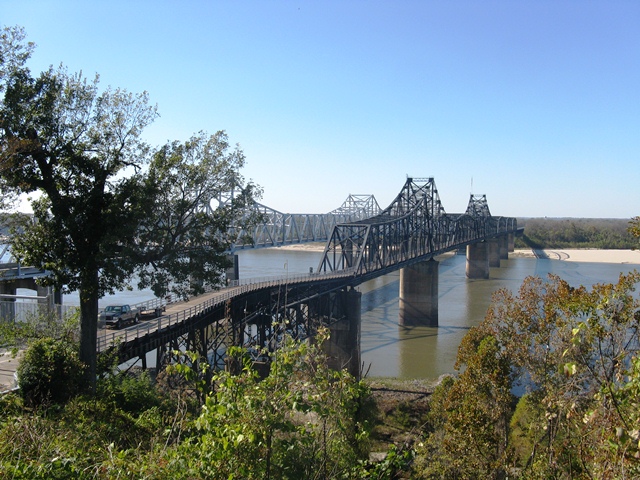
The historic downtown area of Vicksburg is both quaint and somewhat rundown with many storefronts empty like so many small towns we have seen in our travels.  The Casinos have come to town in a big way and that is likely the lifeblood of the region today.  Interstate 20 passes the edge of town and sports a "new" bridge parallel to the former bridge which carried US 80 traffic.
So the old bridge is on the right (that truck is maintenance, not traffic!) and the new I-20 bridge on left.  Note the extensive "beach" on the far side of the river.  Water levels still seem low to us.


Ameristar Casino is our host for this stay as we are parked in their campground across the street from the casino.  We are not casino people and so have not been inside at all.  It is built to resemble a river boat, but is firmly anchored to concrete pilings and is in no danger of floating down river.


This is an interesting landmark to Coca-Cola history as it is the site where Coca-Cola  was first bottled and sold in 1894.  Today it is largely a museum of Coke artifacts and advertising, but still offers ice cream, fountain Cokes, Coke floats and a wide selection of Coke souvenirs.  The building is in the downtown section.


We, frankly, were a little underwhelmed by the historic homes listed for either tours or as bed and breakfast inns.  The origins are old, but the architecture doesn't impress.  Below is the Anchuca Historic Mansion built in 1830 as a wood frame house.  In 1847 it was remade in this Greek Revival style.  It is said, in 1869,  Jefferson Davis greeted neighbors and friends from the balcony over the entry when he visited his brother who died in the house a year later in 1870.

Below is the Duff-Green Mansion from 1858 originally constructed by skilled slave labor.  It served as a hospital for wounded soldiers of both armies during the Civil War. 


The George Washington Ball House, circa 1822, was built by a distant cousin of President George Washington.  After years of neglect, it was restored in 2004 and is a B&B today.


And finally is the Baer House from 1849 which is also a B&B today.


Mississippi River Trip - Part 3 Vicksburg MS

Vicksburg MS

Because of the city's location on the Mississippi River, in the 19th century it built an extensive trade from the river's prodigious steamboat traffic. Between 1881 and 1894, the Anchor Line, a prominent steamboat company on the Mississippi River from 1859 to 1898, operated a steamboat called the City of Vicksburg.

During the Civil War the North had endeavored to close the Mississippi River to all traffic in an effort to choke the South by limiting its access to food, munitions and basic supplies.  But the site of the town was well selected as it sits atop bluffs that rise several hundred feet above the river surface and was an ideal position to defend and a difficult site to attack.  It remained the final major River port city by May of 1863.  General U. S. Grant had made several unsuccessful attempts to attack the fortifications of the city until he decided to besiege the city beginning on May 25. With no reinforcement, supplies nearly gone, and after holding out for more than forty days, the garrison finally surrendered on July 4. This action (combined with the capitulation of Port Hudson on July 9) yielded command of the Mississippi River to the Union forces, who would hold it for the rest of the conflict.


Crater at the 3rd Louisiana Redan

By way of explanation of a little bit of military lingo, a Redan is a French term for a V-shaped feature in a fortification projecting toward an expected attack. 

Late in the siege, Union troops tunneled under the 3rd Louisiana Redan and packed the mine with 2,200 pounds of gunpowder. The explosion blew apart the Confederate lines on June 25, while an infantry attack made by troops from Logan's XVII Corps division, followed the blast. 
The white house to the right in the picture is Shirley's House, also known as the White House, during the siege of Vicksburg, 1863. Union troops of Logan's division set about as engineers and sappers to undermine Confederate fortifications but they had to stay under cover for fear of Confederate sharpshooters.

The North artillery stood amassed while the South employed a scattered artillery strategy.  But when the South fired a volley at Union lines the massed cannons all concentrated on the single enemy piece and neutralized it easily.  Above is part of the Northern artillery line above the crater caused by the blast.

Of course no Military Park would be complete without the many monuments commemorating the service of the many states' army and navy units.  Here is a particularly large memorial from the State of Wisconsin we photographed just for the enjoyment of our Wisconsin readers!

Within the Vicksburg National Cemetery is located the USS Cairo Museum commemorating the recovered remains of a Union Ironclad sunk in the Yazoo River near Vicksburg.  In all 7 such ships were commissioned and built to provide vital cargo transport as well as naval operations in the Siege of Vicksburg. Each was named for a town on the Mississippi.

The Cairo was sunk by the Confederates using a crude underwater mine detonated from shore by a simple battery operated electrical source.  Hidden soldiers waited until the Cairo was over the mine and detonated the device which struck in the section of the hull shown above.  It quickly sank in 36 feet of water but all aboard were rescued by other nearby craft.

The remains were discovered in the 1960s and raised from the bottom 100 years after the Cairo was sunk.  Restoration and reconstruction was completed in 1964 and the results were placed on display.  Above is looking across the boiler tubes toward the stern wheels.

Guess who I caught reading about steam propulsion machinery in the Civil War?


On our first day here we visited the Vicksburg National Military Park which encompasses the fortifications and battle sites.  Also contained within the Park is the Vicksburg National Cemetery which holds the remains of 17,000 Union Soldiers from the Civil War.  It is the most Civil War dead in any cemetery.  Confederate dead from the Vicksburg campaign originally buried behind Confederate lines, have now been re-interred in the Vicksburg City Cemetery (Cedar Hill Cemetery), in an area called "Soldiers' Rest." Approximately 5,000 Confederates have been re-interred there, of which only 1,600 are identified.


Margaret's Grocery


Located north of downtown Vicksburg on old Highway 61, Margaret's Grocery is a unique vernacular art environment created by Reverend H.D. Dennis. Margaret Rogers Dennis ran the former country store for years. When she met and married Reverend Dennis in the early 1980s, he promised her that he would transform her simple store into a place that the world would come to see. 


At the right is a photo from the internet probably taken around 2000.
And, above, is what we found on November 26, 2012, pretty much rubble and ruin.  Recalling that Rev. Dennis who created this was born in 1916, it seems he has reached his promised land.

~~~~~~~~~~~~~~~~~~~~~~~~~~~~~~~~~~~~~~~~~~~

Below is a photo of the Old Court House Museum which was built in 1858-60.  It is considered the finest antebellum structure in Vicksburg.  Today it houses an impressive museum of local and regional artifacts ranging from pre-Columbian tools and implements from the earliest native settlers to a collection of ladies fashions dating from the Civil War era.

There is a separate room displaying personal possessions and documents of Jefferson Davis, President of the Confederacy.  Davis and your scribe have a birthday in common, though he predates me by 133 years.  Also in the museum is an overwhelming display of military hardware and munitions.  It was an educational and enjoyable afternoon.


Friday, November 16, 2012

Mississippi River Trip - Part 2


We stopped at a State park in Arkansas at Lake Chicot.  The lake is the largest oxbow lake in North America and the largest natural lake in Arkansas, formed 600 years ago by the meandering of the Mississippi River.
The name Chicot, French for stumpy, is after the many cypress stumps and trees along its banks. The lake is approximately 3/4 miles wide and 21–22 miles long from end to end.  Many private residences are located along the shores of the lake and the extreme northern end consists of the State Park.


Evenings provided lovely sunsets seen across the lake and through the pecan and cypress trees prevalent here.


Trust me, there are Bald Cypress lining the far shore nearly a mile distant.  We had a lot of cloudy, cool weather while there and did not get many good pictures.  Fishing for crappie, bass, and bream is popular on the lake, especially on the upper end of Lake Chicot during spring and fall. Fishing for catfish is great throughout the year.  A camper nearby to us was from Louisiana and he went out fishing early each morning and returned early afternoon.  I spoke to him and he told me he comes about four times a year for catfish and this time his catch was low!  He said he had "only" about 65 fish in his 4 days when he said he normally gets as many as 175 to take home!  There is no possession limit on catfish on Lake Chicot and two other lakes in Arkansas.  I saw him pack one he estimated to weigh 25 pounds into a cooler.
   

One afternoon I looked outside to see the ground covered by blackbirds apparently feeding on fallen pecans.  They covered at least four times the area shown in this photo!


Dixie was tormented by squirrels such as this visitor to our grill.  I had not seen such coloring on a squirrel before and was pleased to learn it is an Eastern Fox Squirrel.  They would rip and race around the trees chattering all the while and Dixie was frustrated that they climbed just out of her reach and turned to face her!

Tuesday, November 6, 2012

Mississippi River Journey

We had been planning to drive along the mighty Mississippi River for a couple of years, but never seemed to make it because of happenstance.  So this year we are finally doing it.  After a rather eventful trip though Virginia and across Tennessee during which we experienced some engine problems that took a trip to Cummins Factory Service in Knoxville to solve we finally stopped in W. Memphis Arkansas and stayed right on the river bank at Tom Sawyers RV Park.  The pictures below show what we saw every day and river barge traffic runs all day and throughout the night.


Above and below was the sunset on our first night in camp.


Below gives an idea how close to the river we were parked and a typical load of barges being pushed upriver. The standard barge is 195 feet long, 35 feet wide, and can be used in 9-feet of water. Its capacity is 1500 tons. Some of the newer barges today are 290 feet by 50 feet, double the capacity of earlier barges.  I cannot estimate the length of these.  We saw as many as 26 barges being pushed by a single "tow" boat.  The name Towboat is a throwback to the canal era when a single barge was pulled by a team of mules. 


Three or four barges side-by-side and as many as 6 or 7 end-to-end are pushed by the tow.  It looks like there are creature comforts aboard and all the modern electronic navigation equipment too.


And finally the sunset on our last evening here, 
Election Night November 6, 2012.


Yesterday as we finished breakfast, Cathy noticed a bird floating over the river and occasionally diving down  to take something from the water.  We watched it for several minutes and decided it was the American Kestrel and it displayed its characteristic behavior of "hovering" facing into the wind and adjusting only with small wing or tail movements.  When it spotted breakfast, it would dive straight down.  The picture is not mine, but one I found on the internet.


Tomorrow we head farther down the river to Lake Chicot State Park in Arkansas.  I'll tell you more about it in my next post.


Tuesday, October 2, 2012

Selected Photos from Hershey - Summer 2012

Kendalyn on the first day of Fourth Grade!


And Kendalyn on the night before the first day of Fourth Grade.


~~~~~~~~~~~~~~~~~~~~~~~~~~~~~~~~~~~~~~
The Annual Get-together with Cathy's friends from NJ was held on August 29 at an interesting place in White Haven PA called the Powerhouse Eatery.  The site was once and formerly the power generating plant for a Tuberculosis Sanatorium located in White Haven.

The origins of White Haven Center can be traced to August 1901 when a tuberculosis sanatorium was established on 215 acres of farmland in the Blue Mountains of Pennsylvania. Since tuberculosis is caused by various strains of microbacteria and most common among the urban poor, the best treatment was considered to be isolation of the patient at rural sanitaria. White Haven offered an ideal setting due to its clean air and rural surroundings.

The restaurant served very nice meals although the portion sizes may not  have been a hit with all!  Below is the group before lunch was served.  From left and around are Cathy and Larry, Marilyn and Jack Chronister, Bettie LeFevbre, and Justine and Sandy Weinberg.


~~~~~~~~~~~~~~~~~~~~~~~~~~~~~~~~~~~~~~

Kendalyn was able to spend a few weekends with us before she left for the summer at her father's home in Illinois.  And she visited us again after she returned in August.  Here she is at the pool at Thousand Trails.


Laura has been seeing a new friend, Rory Manwiller, on a regular basis and we all got together at Ruby Tuesday's for dinner and a chance to get to know one another better.  The first picture was taken of all at the table by a waitress.


The picture below is a panorama of all taken on Randy's new iPhone5 but he couldn't get it all the way around to include himself!


Get a load of the size of that burger!!!  She took half home by the way.


And finally, one last belly busting lunch at the Hershey Pantry in Hershey.  Cathy's friend Bettie LeFevbre, in the light blue outfit, drove from NJ and stayed over night in a local motel.  Next day we met Jack and Marilyn Chronister, who live somewhat nearby in Mechanicsburg PA, at the Pantry for lunch at 3:00.  We finally cleared out of there at 6:00 after much conversation and too much lunch.


Feathered Feeder Friends

Our bird feeders at Thousand Trails Hershey have been getting lots of regular visitors.  Hope you will enjoy these pictures. 


The Mourning Dove above has many friends and they serenade us morning and evening.


Ooops!  This isn't a feathered friend at all.  It is the hanging basket Randy got his Mom for Mother's Day.


European or House Finch


American Goldfinch


Male Downy Woodpecker (The males are always prettier!)


Ruby Throated Hummingbird, Female


Dixie after a bath.  Also not a feathered friend.


Bedtime.


This is the Red Breasted Nuthatch and is a new sighting for us.  Above is the Female and below is the Male.


We also saw for the first time a Cedar Waxwing but never with a camera handy.  Apparently they stay only a short time in the spring and early summer and then move on.  Other regular visitors to our diner included the cardinals, chickadees, sparrows, titmouse, wrens and we saw northern orioles in the treetops but got no photos!


Our new Squirrel Buster feeder really works.  The outer cage is mounted on a soft spring that collapses with more than a pound on it and closes off the seed ports.  It is so effective the squirrels don't even try anymore.  It also thwarted the Grackles as they could not perch on the small wire perches and could not cling to the mesh and still reach the seeds.